


ACRU Policy Board Member Col. Allen B. West expresses ACRU’s support for Texas lawsuit demanding state legislative authority over election protocols be upheld
 “The lawsuit filed by Texas against Michigan, Georgia, Pennsylvania, and Wisconsin is needed to protect the American electoral process from executive and judicial actions that usurp the constitutional powers of state legislators. ACRU encourages principled leaders across the country to join Texas in the fight against assaults on election integrity and the Constitution.”
Honestly conducted elections, with each American’s vote counting once, is the foundation of a nation whose Constitution begins “We the People…”
The government derives its legitimacy from free and fair elections and is bound by them. Vote fraud cuts at the very heart of American freedom. When an illegal vote is cast and counted, it cancels out the legal vote of a lawful citizen. (Watch the undercover videos).
In recent years, close elections and news of vote fraud have awakened Americans to the importance of protecting the integrity of the ballot box.
This site is a one-stop shop about voting requirements in every state, current state efforts to strengthen ballot integrity and the push-back from the Left.
Get involved — help prevent vote fraud from stealing your most precious civil right!
ACRU is dedicated to protecting seniors from vote fraud. Through our Protect Elderly Votes project, we created “Stranger Danger” to warn seniors and those caring for them to take steps to protect their ballots. If you suspect vote fraud, call ACRU’s Vote Fraud Hotline at 877-730-ACRU (2278). NEVER LET A STRANGER TOUCH YOUR BALLOT!
Listen to our new radio ads to learn more.
ACRU Commentary
List of Voter Fraud Cases Keeps Growing
The Heritage Foundation's list of nearly 300 documented cases of voter fraud in the United States continues to grow. Recent additions reveal that voter fraud is not just an individual or isolated crime; in some counties and communities, election fraud is almost a way of life. These additions again reinforce the need for measures such as voter ID laws and procedures designed to verify the accuracy of voter registration information are needed to prevent these crimes in the first place. Take East Chicago, Ind., for example, a town made infamous by the extensive voter fraud that occurred there in the 2003 Democratic mayoral primary election. The Daily Signal is the multimedia news organization of The Heritage Foundation. We'll respect your inbox and keep you informed. The fraud was so pervasive that the Indiana Supreme Court overturned the results of the primary and ordered a new special election that resulted in a different winner. A local judge found "direct, competent, and convincing evidence" that supporters of the election's apparent victor, incumbent Mayor Robert Pastrick, orchestrated an elaborate scheme of absentee ballot fraud.
Will Supreme Court End Political Subsidy to Illegal Aliens?
By J. Christian Adams The United States Supreme Court has been asked to end a political subsidy to aliens through the use of alien population in allocating legislative seats. In a case arising out of the decision by Texas to count aliens -- illegal and legal -- in drawing legislative districts, the Supreme Court will hear arguments on whether using aliens violates the principle of "one person, one vote." The case is Evenwel vs. Abbott. Currently, many states count aliens when establishing the population of legislative districts, therefore diluting the legislative clout of citizens. Legislative districts -- whether for Congress, a state legislature, or a county council -- must be more or less equal in population. The case before the Supreme Court will decide what population must be used to calculate that "population." If Texas prevails, illegal aliens and noncitizens may be counted. This means areas with high alien population will dilute the legislative clout of areas where the residents are almost all citizens.
Election Reform in North Carolina and the Myth of Voter Suppression
By Hans von Spakovsky In 2013, North Carolina passed omnibus electoral reform legislation that, among other provisions, eliminated same-day registration, required that qualified persons who desire to vote in an election must register to vote no later than 25 days before Election Day, reduced the number of early voting days from 17 to 10, and created a voter ID requirement. Although opponents of this bill predicted that such reforms would disenfranchise minority voters and significantly suppress voter turnout, turnout actually increased. African-American voter turnout increased by almost 30 percent and Caucasian voter turnout increased by approximately 15 percent. Clearly, these changes did not suppress voter turnout.
Revisiting the Lessons from the Voter ID Experience in Texas: 2015
By Hans von Spakovsky Critics of the Texas voter identification law claim that a voter ID requirement suppresses voter turnout. However, turnout data from elections held with the voter ID law in place show that there is no evidence whatsoever that this requirement has prevented Texans from turning out to vote. In fact, turnout increased during the 2013 state elections--despite the enactment of the new voter ID requirement. Likewise, during the 2014 midterm elections--a contest that saw voter participation plummet across the U.S.--turnout in Texas declined at a smaller rate than the national average and a smaller rate than the rates in 12 states that have no ID requirement.
Symposium: Does “one person, one vote” really mean what it says?
By Hans von Spakovsky in Scotusblog Evenwel v. Abbott may wind up being the most important voting case in sixty years. Its political ramifications could rival those of Reynolds v. Sims, the 1964 case that established the principle of "one person, one vote" under the Equal Protection Clause of the Fourteenth Amendment. The key question in Evenwel is what population does that principle require legislatures to use when they are redrawing legislative districts? Prior to Reynolds, states like Alabama and Tennessee had refused to redistrict for more than half a century, despite a dramatic, nationwide population shift from rural to urban areas. These state legislatures were dominated by rural legislators, who were not willing to reapportion and lose their power and control. Under the principle established in Reynolds, districts have to be drawn "on a basis that will insure, as far as is practicable, that equal numbers of voters can vote for proportionally equal numbers of officials." Within two years of the Reynolds decision, legislative districts had been redrawn in almost every state, and urban areas gained a substantial number of legislative seats. Today, lawmakers from urban areas dominate many state legislatures because of the huge influx of non-citizens, both legal and illegal, into predominantly urban settings. This greatly increases the population of non-voters who can be and are used to fill in urban legislative districts. If the Court rules for the plaintiffs, there could be a similar loss of clout by urban areas that rural districts experienced after Reynolds. In this case, Sue Evenwel and Edward Pfenninger are contesting the state senate districts drawn by the Texas legislature in 2013. The legislature used total population in determining whether the population of each senate district met equal protection requirements. Evenwel, a registered voter in Senate District 1, and Pfenninger, a registered voter in Senate District 4, filed suit because both the number of citizens of voting age and the number of registered voters in these two districts deviate substantially - between thirty-one and forty-nine percent - from the "ideal" population of a Texas senate district.
No Vote Fraud? Here Are Five Cases in 2015
By Hans von Spakovsky (ACRU Policy Board member) and Brandon Johnson Despite being only six months into 2015, there have already been a slew of sometimes bizarre stories about voter fraud across the country. They show just how far some people will go to cheat the system. Here are a few of the most outlandish stories: 1. Madison County, Ga. Mohammad Shafiq of Madison County, Georgia, was none too happy with Madison County sheriff candidate Clayton Lowe. So Shafiq started campaigning for the other candidate by submitting fraudulent voter registration cards supposedly for new voters, apparently intending to eventually vote under those registrations. When the fraud was detected, he coerced a couple to sign affidavits falsely saying they had registered themselves. He was charged with two counts of voter identification fraud, two counts of perjury, and three counts of tampering with evidence. He pleaded guilty and was sentenced to 10 years probation and a fine of $6,750.


Latest Election News
The media’s greatest power is the power to ignore
Sixty-two percent of Americans believe voting by mail increases fraud. So we reviewed mainstream media vote fraud stories and found nearly every story started with, “GOP to fight voter fraud that doesn’t exist.” The bias willingly ignores fraud despite reams of evidence. Author Gore Vidal once quipped, “Half the American people never read a newspaper. Half never vote for President — the same half?” Glad you read the EIB.

A General’s analysis of the dangers of mail-in voting
Leave it to an Army general to analyze, summarize and finalize the dangers of mail-only voting, succinctly, using data, and then give marching orders to the concerned. In a letter to the North Carolina Pilot, Lt. Gen. Marvin Covault (ret.) uses years of experience and all three of his stars to recognize that mail-only voting is the enemy of vote integrity.
Because you might be sick on election day
Connecticut law permits absentee voting for people away on election day, serving in the military, or disabled. The state’s Democrat executive—with no legal authority—wants to expand that to anyone who thinks they might get sick. The state’s GOP is suing to prevent this unlawful strategy. Perhaps people who know they are going to be sick on election day should be picking lottery numbers for the rest of us.
More proof that mail-only voting is an electoral train wreck
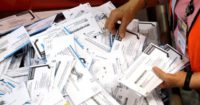
When it comes to fighting against universal mail-only ballots, ACRU is a purposeful broken record. We have noted repeatedly these ballots go to 1. The deceased. 2. People who moved. 3. Non-citizens. In Michigan, hundreds returned universal ballot applications that went to 1. The deceased. 2. People who moved. 3. Non-citizens. Addresses don’t vote, and politicians don’t listen.

California Court shuts down Governor’s mail-only ballot edict
California’s Democrat Governor Gavin Newsom is not a legislator and has no legal authority to demand an all mail election—only the state legislature does. This was recently explained to him by a California judge who read the law. According to the Election Integrity Project of California, about 648K people who are dead, moved, never voted, or over 105 years old would receive ballots under Newsom’s scheme. We call that open season for fraud.

PDF Download: Defending Honest Elections in America
