


ACRU Policy Board Member Col. Allen B. West expresses ACRU’s support for Texas lawsuit demanding state legislative authority over election protocols be upheld
 “The lawsuit filed by Texas against Michigan, Georgia, Pennsylvania, and Wisconsin is needed to protect the American electoral process from executive and judicial actions that usurp the constitutional powers of state legislators. ACRU encourages principled leaders across the country to join Texas in the fight against assaults on election integrity and the Constitution.”
Honestly conducted elections, with each American’s vote counting once, is the foundation of a nation whose Constitution begins “We the People…”
The government derives its legitimacy from free and fair elections and is bound by them. Vote fraud cuts at the very heart of American freedom. When an illegal vote is cast and counted, it cancels out the legal vote of a lawful citizen. (Watch the undercover videos).
In recent years, close elections and news of vote fraud have awakened Americans to the importance of protecting the integrity of the ballot box.
This site is a one-stop shop about voting requirements in every state, current state efforts to strengthen ballot integrity and the push-back from the Left.
Get involved — help prevent vote fraud from stealing your most precious civil right!
ACRU is dedicated to protecting seniors from vote fraud. Through our Protect Elderly Votes project, we created “Stranger Danger” to warn seniors and those caring for them to take steps to protect their ballots. If you suspect vote fraud, call ACRU’s Vote Fraud Hotline at 877-730-ACRU (2278). NEVER LET A STRANGER TOUCH YOUR BALLOT!
Listen to our new radio ads to learn more.
ACRU Commentary


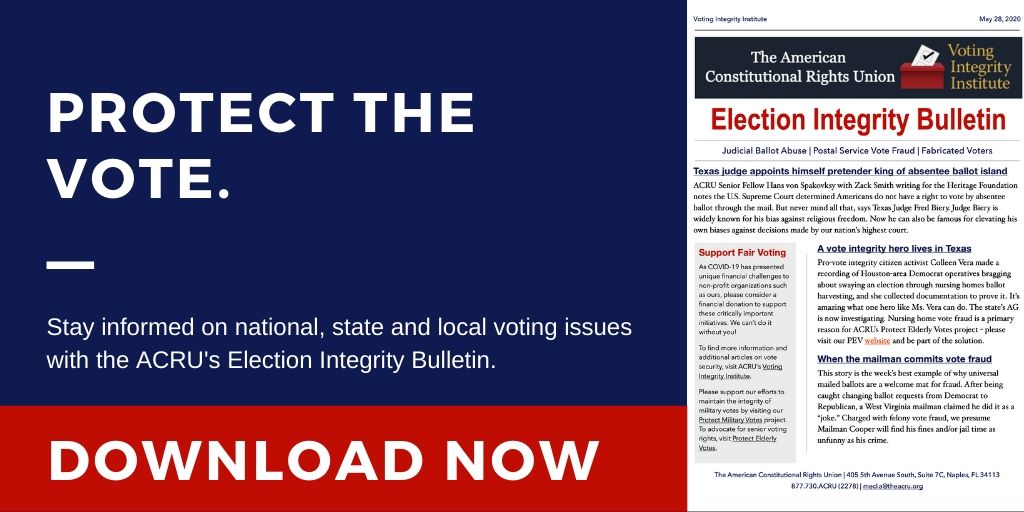
Latest Election News
Court Date Set for Texas Voter ID Law
A May 24th court date has been set to re-hear the case surrounding the Texas Voter ID law. In August, the 5th Circuit Court of Appeal ruled the law violates part of the Voting Rights Acts. However a majority of the full, 15-member court wants to reconsider the case. The voter ID law requires millions of registered voters to show a picture ID at the polls.
ACLU Sues Kansas over Proof-of-Citizenship Voting Law
KANSAS CITY, Mo. -- Tens of thousands of people in Kansas are being deprived of their right to vote, the American Civil Liberties Union argued in a lawsuit filed on Feb. 18 that challenged a state law requiring residents to show proof of citizenship when they register to vote. The suit is the latest to take direct aim at a three-year-old measure ushered into law by Secretary of State Kris W. Kobach, who has lobbied heavily over the years for measures that he said were needed to prevent non-citizens from casting ballots. The ACLU, arguing that fraud claims were unfounded, brought the class-action suit in federal court on behalf of six Kansas residents who said they were left off the voter rolls after registering at the state's Department of Motor Vehicles. Passed by its Republican-dominated legislature five years ago, the law requires residents to show proof of citizenship when they register.
CBS Evening News Sounds the Alarm Playing the Race Card Against Voter ID Laws
Amidst their voluminous Super Tuesday 3 coverage, the CBS Evening News found just over two minutes to trot out the tired liberal argument that voter ID laws, like the one in North Carolina, have a racist angle. Anchor Scott Pelley set the scene from the start of the segment before correspondent Mark Strassamann took over by making it clear that it would be a left-leaning piece on the issue: "In North Carolina, about 1,000 voters cast provisional ballots because they didn't have enough identification to meet the state's new, strict voter ID law. The law was passed even though voter fraud is almost unknown there. Opponents say the law is meant to silence minority voters."
Non-Citizen Voting Case Pits Justice Department Against States that Require Proof-of-Citizenship
By Hans von Spakovsky The free-for-all boxing match between the U.S. Election Assistance Commission (EAC), the League of Women Voters, the NAACP, Kansas, and the U.S. Department of Justice (DOJ) resumed on Wednesday, March 9. They're tussling over the right of states to require proof-of-citizenship from people using the federal voter registration form. In Courtroom 18 of the D.C. federal courthouse, Judge Richard Leon presided over a sometimes contentious hearing on the plaintiffs' request for a preliminary injunction that would rescind the Election Assistance Commission's change of the instructions on the federal voter registration form to accommodate a request by Kansas. The Sunflower State wants the form to note that Kansans wishing to register must meet a proof-of-citizenship requirement. At the first hearing in this case on Feb. 22, Leon refused to grant a temporary restraining order requested by the League of Women Voters and the NAACP, the plaintiffs who don't want the Election Assistance Commission to mention proof-of-citizenship. Justice Department Unwilling to Defend Election Assistance Commission Normally, the Justice Department would be expected to defend the Election Assistance Commission in court. Instead, the Justice Department lawyers tried to throw the case by agreeing to a temporary restraining order. Leon expressed astonishment at the Department of Justice's behavior, calling it "unprecedented" and "extraordinary." Rather than take that as a warning about the Department of Justice's potentially unethical and unprofessional behavior in refusing to carry out its duty to defend its client, the Federal Programs Branch came into this week's hearing once again trying to lose the case.
Court to Hear Appeal of Ruling Striking Down Texas Voter ID Law
AUSTIN -- The full 5th U.S. Circuit Court of Appeals will to hear arguments on the constitutionality of the Texas voter identification law, the court said late Wednesday. The move, in response to a request by Texas Attorney General Ken Paxton, is the latest step in a case that seems destined for the U.S. Supreme Court. Last year, a panel of three judges on the appeals court issued a complicated ruling that largely was applauded by the plaintiffs in the case -- which include several civil rights groups and U.S. Rep. Marc Veasey, D-Fort Worth -- when it said the state's voter ID law violates the U.S. Voting Rights Act through its discriminatory effects. The panel affirmed a portion of a ruling by U.S. District Court Judge Nelva Gonzales Ramos of Corpus Christi, rejected another piece of it and sent other portions back to the lower court for further review. Later that month, Paxton asked the whole court to rehear the case, Veasey v. Abbott. In its order Wednesday, the court didn't specify a date to hear the case. Paxton responded Wednesday by saying the order "is a strong step forward" in the state's defense of the law. "Safeguarding the integrity of our elections is a primary function of state government and is essential to preserving our democratic process," he said in a statement. "We look forward to presenting our case before the full Fifth Circuit." Chad Dunn, an attorney for the lead plaintiff, said he looks forward to presenting the case. "So far, seven federal judges have already struck down Texas' voter photo identification law because it is the most complicated, discriminatory and burdensome such law in the country," he said.

PDF Download: Defending Honest Elections in America
