


ACRU Policy Board Member Col. Allen B. West expresses ACRU’s support for Texas lawsuit demanding state legislative authority over election protocols be upheld
 “The lawsuit filed by Texas against Michigan, Georgia, Pennsylvania, and Wisconsin is needed to protect the American electoral process from executive and judicial actions that usurp the constitutional powers of state legislators. ACRU encourages principled leaders across the country to join Texas in the fight against assaults on election integrity and the Constitution.”
Honestly conducted elections, with each American’s vote counting once, is the foundation of a nation whose Constitution begins “We the People…”
The government derives its legitimacy from free and fair elections and is bound by them. Vote fraud cuts at the very heart of American freedom. When an illegal vote is cast and counted, it cancels out the legal vote of a lawful citizen. (Watch the undercover videos).
In recent years, close elections and news of vote fraud have awakened Americans to the importance of protecting the integrity of the ballot box.
This site is a one-stop shop about voting requirements in every state, current state efforts to strengthen ballot integrity and the push-back from the Left.
Get involved — help prevent vote fraud from stealing your most precious civil right!
ACRU is dedicated to protecting seniors from vote fraud. Through our Protect Elderly Votes project, we created “Stranger Danger” to warn seniors and those caring for them to take steps to protect their ballots. If you suspect vote fraud, call ACRU’s Vote Fraud Hotline at 877-730-ACRU (2278). NEVER LET A STRANGER TOUCH YOUR BALLOT!
Listen to our new radio ads to learn more.
ACRU Commentary


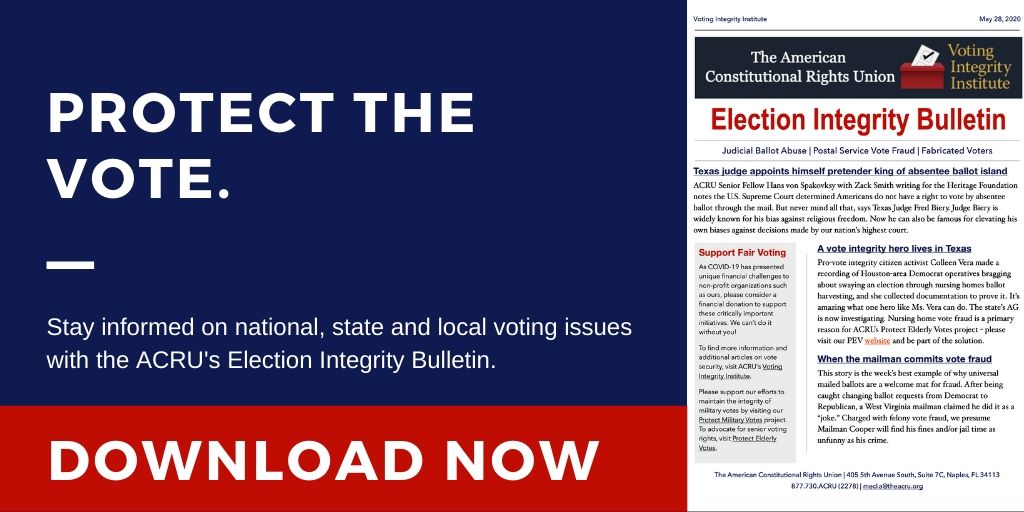
Latest Election News
How an Alabama Woman Used Voter Fraud to Get Her Boyfriend Elected
In Dothan, Ala., the verdict is in: it was election fraud. Last week, a jury convicted 66-year-old Olivia Reynolds on 24 felony counts of absentee ballot fraud in the contested 2013 election for the Dothan City Commission. Reynolds worked on the re-election campaign for District 2 incumbent Amos Newsome. During the tainted 2013 election, she forged and altered enough absentee ballots to guarantee victory for her boss and boyfriend. The verdict will only come as a shock to those who still insist that voter fraud simply doesn't exist in the U.S. In 2013, Newsome narrowly won reelection to his office, besting challenger Lamesa Danzey by a scant 14 votes. However, after Danzey identified at least 37 absentee ballots that she claimed were illegally cast, the Houston County Sheriff began investigating irregularities in the District 2 race. Danzey, it turned out, had won the in-person vote by a hundred votes, 343-243. But Newsome had carried a whopping 96% of the absentee vote, winning 119 of the 124 ballots cast by mail. That was enough to tip the scales in the incumbent's favor - and to raise the eyebrows of investigators given how much the margin of absentee ballots cast for Newsome differed from the margin of votes cast for him on Election Day. Interestingly, this was not the first time Newsome had lost the in-person vote but carried the absentee vote by wide margins. In 2011, he lost at the polls by 45 votes, yet won 131 absentee ballots - all but 9 cast that year. The Sheriff's investigation culminated in the arrest of Reynolds and three others. Three of the four have now been convicted in what appears to have been an organized conspiracy to deny the citizens of Dothan their right to free and fair elections. Investigators found that the defendants had fraudulently applied for and submitted absentee ballots for registered voters. During Reynolds' trial, it was revealed that she went even further. Witnesses testified that she ordered them to vote for Newsome. Four witnesses confirmed they had done so even though they intended to vote against him. In some cases, Reynolds illegally filled out part or all of voters' ballots for them. In the course of the trial, some voters discovered their ballots had evidently been cast for Newsome, even though they had never voted for him. Alabama law requires that absentee votes must be observed by two witnesses, to safeguard against fraud. But the case reveals how easy it is to circumvent that requirement - and just how insecure absentee ballots are. In fact, absentee ballot fraud is one of the most common forms of election fraud. Reynolds' attorney, Chris Capps, responded to the charges against his client with allegations of racism on the part of prosecutors and law enforcement. The city of Dothan, Capps said, was just out to get Newsome and undermine the ability of a minority district to vote absentee. Of course, Capps wanted jurors to overlook the fact that the primary victims of Reynolds' fraud were the minority residents of District 2 whom she effectively disenfranchised. Such false claims are sadly common in the debate over election fraud. Opponents characterize efforts to ensure the integrity of the electoral process, such as requiring photo ID for both in-person and absentee voting, as little more than an attempt to suppress minority votes. In reality, nothing of the kind is true. Often these claims, such as in this case, are merely an attempt to distract the public from the criminal activity of the defendants and to deter and scare prosecutors from proceeding. Analysis has revealed that minority turnout has actually increased in states with photo ID requirements. At trial, Assistant District Attorney Banks Smith reminded jurors and the public that voter fraud cases are not about political agendas or racially-motivated attacks. "This case is about the sanctity of the ballot." And jurors, it seems, paid attention. The evidence was so overwhelming it took less than an hour for the jury to return a guilty verdict. Reynolds is the third person convicted of absentee ballot fraud in connection with the Newsome campaign. Though Commissioner Newsome himself has not been directly fingered for criminal conduct, the legitimacy of his election has clearly been called into question.
One Person, One Vote: Advancing Electoral Equality, not Equality of Representation
By Hans von Spakovsky and Elizabeth Slattery The Supreme Court has held that the Fourteenth Amendment's Equal Protection Clause includes a "one-person, one-vote" guarantee requiring voting districts to be drawn "on a basis that will insure...that equal numbers of voters can vote for proportionally equal numbers of officials." So far, states have been free to choose which population category to use, such as total population, voting-age population, citizen voting-age population, citizen-eligible voting-age population, or some variant thereof, as long as the Constitution does not forbid it. Now, in what may be the most important voting case in 50 years, Evenwel v. Abbott, the Supreme Court is presented in its October 2015 term with the chance to clarify whether the "one person, one vote" principle includes a judicially enforceable right to ensure that voters are not denied an equal vote.
Nevada GOP Activist Files for Voter ID Ballot Measure Petition
CARSON CITY - Conservative activist Sharron Angle wants Nevada voters to decide whether to abolish the state health insurance exchange and require photo identification at the polls. The Republican former assemblywoman and former U.S. Senate candidate filed two petitions last week with the Nevada Secretary of State. Proponents would need to gather more than 55,000 signatures from all over the state to get either measure on the 2016 ballot. Each would need to pass two consecutive elections to become a constitutional amendment. One proposes banning the exchange created as part of President Barack Obama's health care overhaul. The other proposes requiring proof of identity before casting a vote, and requiring the government to issue ID cards to those without one.
ACLU Moves to Strike Down Kansas Citizenship Voting Rule
The American Civil Liberties Union and Secretary of State Kris Kobach jockeyed for legal advantage Friday in a court case challenging Kobach's implementation of the state's voter proof-of-citizenship law. Representing Kansas voters who can cast ballots in federal races, but not state and local elections, the ACLU filed a motion for summary judgment that would strike down Kobach's two-tier voting system without a trial. Nearly simultaneously, Kobach filed a motion that would allow him to immediately appeal a judge's ruling that he overstepped his authority by dividing voters into two voting camps, those who registered using a state form and those who registered using a federal form. The case is important because it could let people work around a state law - authored by Kobach - that requires prospective registrants to show documents proving their citizenship before they are granted voting privileges. The proof-of-citizenship requirement is separate from the requirement that voters have to show photo ID when they cast a ballot. While a driver's license is sufficient for Election Day voter ID, the state's voter-registration form requires a higher level of documentation. That can usually be met only with a birth certificate, passport, or special papers issued to foreign-born and tribal citizens. The federal registration form accepts a sworn statement from the voter, signed under penalty of perjury, as proof of citizenship. At Kobach's direction, only voters who can document proof of citizenship are allowed to vote in all federal, state and local elections. Voters who register with the federal form without providing their citizenship papers are only allowed to vote in federal races for president and members of Congress.
Texas Seeks Full Court Rehearing on Voter ID Law
Texas has asked the full bench of the U.S. Court of Appeals for the Fifth Circuit to rehear civil rights plaintiffs' case against the state's voter ID law after a three-judge panel from the same court ruled that the law discriminates. Because the state's request for a rehearing is pending, and since Texas may also seek a hearing at the U.S. Supreme Court, the Fifth Circuit in a Sept. 2 order rejected civil rights plaintiffs' proposals to have the litigation remanded to the trial court, where a judge could have ordered Texas to immediately start changing how it identifies voters. "We will get those decisions pretty quickly," Rolando Rios, of San Antonio's Law Office of Rolando L. Rios, said about the rulings on the en banc Fifth Circuit and Supreme Court hearings. Rios represents the Texas Association of Hispanic County Judges and County Commissioners, which is an intervening plaintiff in the litigation. But the U.S. Department of Justice, which has sided with the civil rights plaintiffs in the litigation, wants to avoid any wait for Texas to redo its voter ID procedures. To that end, the DOJ also filed on Sept. 2 a motion requesting that the Fifth Circuit enter an injunction directing Texas to accept as sufficient valid voter registration certificates from voters who lack the specific list of documentation required under the law SB-14, which the Fifth Circuit's three-judge panel struck down. Passed in 2011, SB-14 requires voters to show specific government-issued photo identifications. Among the identifications the law allows voters to show: driver's licenses, concealed handgun licenses, U.S. military identifications, U.S. passports or other U.S. citizenship certificates.

PDF Download: Defending Honest Elections in America
